


— 日本語 — [English below]
アバウト|作家について
bones2boil は東京を拠点に活動するアーティストです。
糸や布、木材など実際に手で触れることのできる素材を用い、ラグ、壁面、立体作品など、空間の中で成立するアートを制作しています。
すべての作品はキャラクターや形、素材、触覚を探求する長期的なアートプロジェクト「TOSHO」の一環として制作されています。
コンセプトの構想からデザイン、制作、仕上げに至るまで、すべての工程を自身のスタジオで手作業により行っています。
• • • • • • • • • • • • •
表現の出発点はひとつのキャラクターだった。
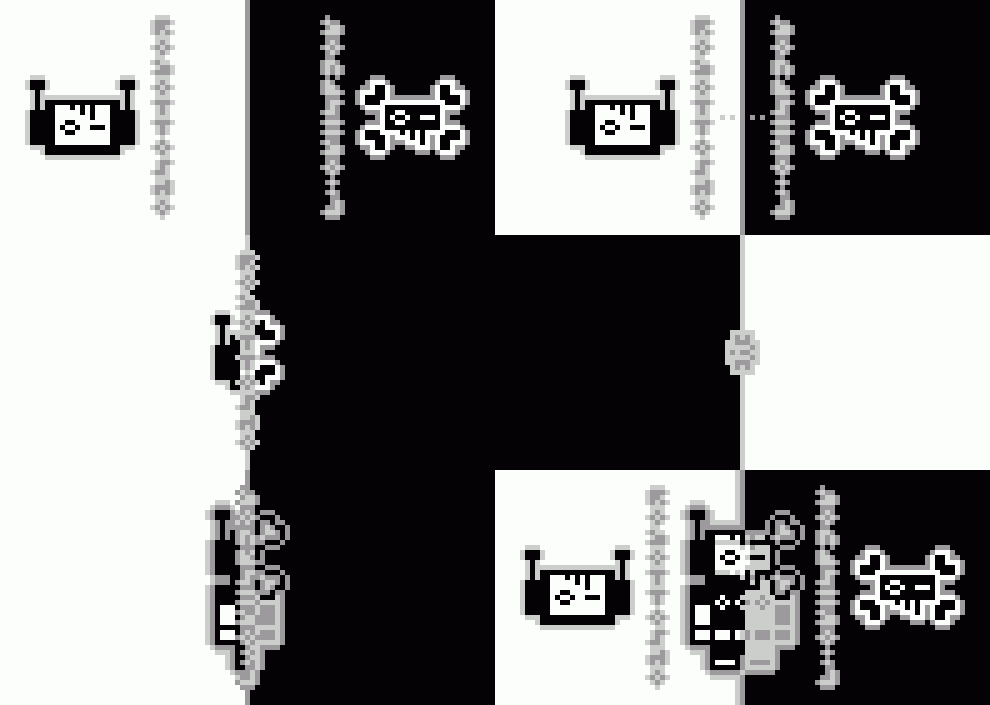
TOSHO [ |+ -| ] はノートの方眼紙に手描きされたピクセルの「ロボット・チェブラーシカ」から始まった。
2007年、それはシンプルなペイントソフトの中で8ビットの存在へと変化した。
すべてはそこから始まった。
現在に至るまで続くビジュアルシステムは、このキャラクターを中心に形成されている。
やがてTOSHOという名前は単なるキャラクターを超え、作者自身を指す存在にもなった。
それはスタイルの原点であり、構造の基盤となっている。
TOSHOは純粋なピクセルの論理。
最小単位。
モジュール。
構造。
ピクセルという最小の要素から世界が構築されるという発想は、初期にはデジタル表現として展開された。
グラフィック、シンプルな8ビットアニメーション、モニター上の美学。
その後デザインは衣服やさまざまな媒体へと広がり、ストリートウェアの展開やコラボレーション、ファンアートなどを通じて発展していった。
やがて画面の外へ出る必要性が生まれる。
物理的な「ピクセル」への関心。
正方形のモジュール、タイル、木材などを用いてイメージを構築する試み。
こうしてピクセル構造によるウォールアートという方向性が生まれた。
モザイクパネル、立体作品、空間に存在する構造体。
デジタルの構造を現実空間へ移行させるための方法である。
並行して、もうひとつの流れが発展した。
ステッカーやプリント、衣服に見られるような、ストリートカルチャーに近いグラフィック。
より自由な線、そしてより有機的なリズム。
それは直接的なストリートアートではなく、その視覚的エネルギーをインテリアへと適応させた表現。
ここで現れたのが、もう一つの存在—bones2boil。
TOSHOがピクセルの厳格な構造であるなら、bones2boilはピクセルと自由なグラフィックの両方を内包する拡張されたシステム。
対立ではなく、拡張。
現在はこの二つの状態のあいだで意識的に制作が行われている。
・TOSHO — 原点となるモジュール構造
・bones2boil — 拡張された表現ベクトル
スタイルは一貫したビジュアルコードに基づきながら、表現手法は常に変化している。
新しいスタイルを模索しているのではない。
求めているのは、最適な素材である。
約20年にわたり、このプロセスは計算や流行とは無関係に継続されてきた。
それはプロジェクトではなく、人生の一部である。
現在はその歩みを作家として自覚的に続けている。
作品は必ずしも明確な機能を持たない。
しかし空間の中に存在し、リズムと個性を与える。
もしその一つが誰かの空間に置かれるなら、プロセスはそこで新たに続いていく。
• • • • • • • • • • • • •
— English —
ABOUT|Artist Info
I am bones2boil, an artist based in Tokyo, Japan.
I create tactile art objects for interior space — rugs, wall works, and sculptural pieces — working with fiber, tile, wood, and other physical materials.
All of my works are created as part of TOSHO, a long-term artistic project exploring character, form, material, and touch.
From concept and original design to production and finishing, every stage of the process is carried out by hand in my studio.
• • • • • • • • • • • • •
The language of this work began with a character.
TOSHO [ |+ -| ] — a pixel “robot-Cheburashka,” first drawn by hand in a squared notebook and later translated into 8-bit form using a simple painting program in 2007.
Everything started there.
The entire visual system that continues today was built around this figure.
Over time, the name TOSHO became associated not only with the character, but with the artist. Friends often said it felt like a self-portrait, and many knew the name without knowing the real one. It became the foundation of a visual identity.
TOSHO represents pure pixel logic.
Minimal form.
Module.
Structure.
The idea of the pixel as the smallest unit from which a whole world can be constructed has always been central. Initially this existed in digital space: graphics, primitive 8-bit animation, monitor-based aesthetics.
Later, the designs moved beyond the screen — onto clothing and other mediums, through streetwear projects, collaborations, and reinterpretations by others.
Eventually, working physically became essential.
This led to an interest in material “pixels” — square modules, tiles, wood, and other elements used to literally assemble an image. From this emerged a direction that can be described as pixelated wall art: mosaic panels, objects, sculptural forms. A translation of digital structure into physical space.
Alongside this, a second direction developed.
Closer to street culture — graphics seen on stickers, prints, and garments. A freer line. A more fluid rhythm.
Not street art in a direct sense, but its visual energy adapted for interior space.
Within this dimension, a second presence appeared: bones2boil.
If TOSHO is the discipline of the pixel, bones2boil exists across both the pixelated and the more expressive graphic realms. It is not a contradiction, but an expansion of the same system.
Today, both states coexist intentionally:
• TOSHO — the modular origin
• bones2boil — the expanded artistic vector
The visual code remains consistent and self-contained, while the methods of execution continue to evolve.
The search is not for a new style, but for the right material.
For nearly two decades, this process has continued independently of trends or strategic calculation. What began intuitively is now consciously acknowledged as a lifelong practice.
The work may not always serve a utilitarian function, but it exists within space — adding rhythm, character, and individuality.
If a piece enters someone’s environment, the process simply continues there.
アートギャラリー | Art Gallery
— 日本語 —
Experience|体験について
この作品は、視覚だけで完結するものではありません。
触れること。
素材の凹凸を感じること。
近づき、距離を取り、空間の中で存在を確かめること。
タイルの硬さ、木材の質感、繊維の柔らかさ。
ピクセルは単なる視覚的構造ではなく、
物理的な単位として現れます。
デジタルから生まれた論理は、現実の重さや温度を持つ。
触れることで初めて成立する関係性。
それは鑑賞というより、対話に近い。
作品は「見るもの」ではなく、
空間の中で身体とともに存在するものです。
• • • • • • • • • • • • •
— English —
Experience
These works are not meant to exist only visually.
They invite proximity.
They allow touch.
They respond to distance and movement within space.
The hardness of tile, the grain of wood,
the softness of fiber — the pixel becomes
a physical unit, not just a graphic element.
What began as digital logic gains weight,
texture, and temperature.
Touch is not decoration.
It completes the work.
Rather than passive viewing,
the relationship becomes spatial and bodily.
The object does not simply hang on a wall
— it occupies space with you.
• • • • • • • • • • • • •
触れられるアート | Art you can touch
• • • • • • • • • • • • •
ArtMaKing △△△ Your Personal Rug Dealer
• original hand crafted art rugs
TOSHO [ |+ -| ] ROBOT
• streetwear brand [archive]
1FKNGPXL ∇∇∇ Pixelated Wall Art
• mosaic-based art
• • • • • • • • • • • • •
Touch My Art
.△△△.
[ |+ -| ]
.∇∇∇.
bones2boil
